A Day in the Life: Mobile Windshield Replacement on a Central Oregon Winter Morning
Learn the details of an expert's approach to windshield replacement in Bend
The phone vibrated on the nightstand at 6:47 AM, pulling Jake Reynolds from the last remnants of sleep. Outside his Bend home, the December darkness was absolute, and the temperature display on his phone read 18°F. Twenty years as a mobile auto glass technician had trained him to wake quickly—customers calling before 7 AM usually had urgent needs.
"This is Jake," he answered, already swinging his legs out of bed.
The voice on the other end belonged to Sarah Martinez, a single mom from northeast Bend. Her Honda CR-V had developed a small chip three weeks ago—just a tiny star-shaped impact from a rock on Highway 97. She'd meant to get it fixed, kept meaning to, but between work and kids and the chaos of daily life, it had slipped down her priority list. Then last night, when temperatures dropped to fifteen degrees, she'd heard it: a sharp crack that echoed through her garage. This morning, an eight-inch fissure spread across her windshield like a frozen lightning bolt.
"I called the progressive glass claims phone number last night," Sarah explained, words tumbling out quickly. "They approved everything overnight. But I need my car for work by nine. Is that even possible?"
Jake was already mentally calculating. Bend to her neighborhood—twelve minutes. Installation time—ninety minutes if everything went smoothly. Cure time before she could safely drive—that was the complication.
"I'll be there by 7:30," he promised. "We need to talk about cure time, but let's get started and we'll figure out your work situation."

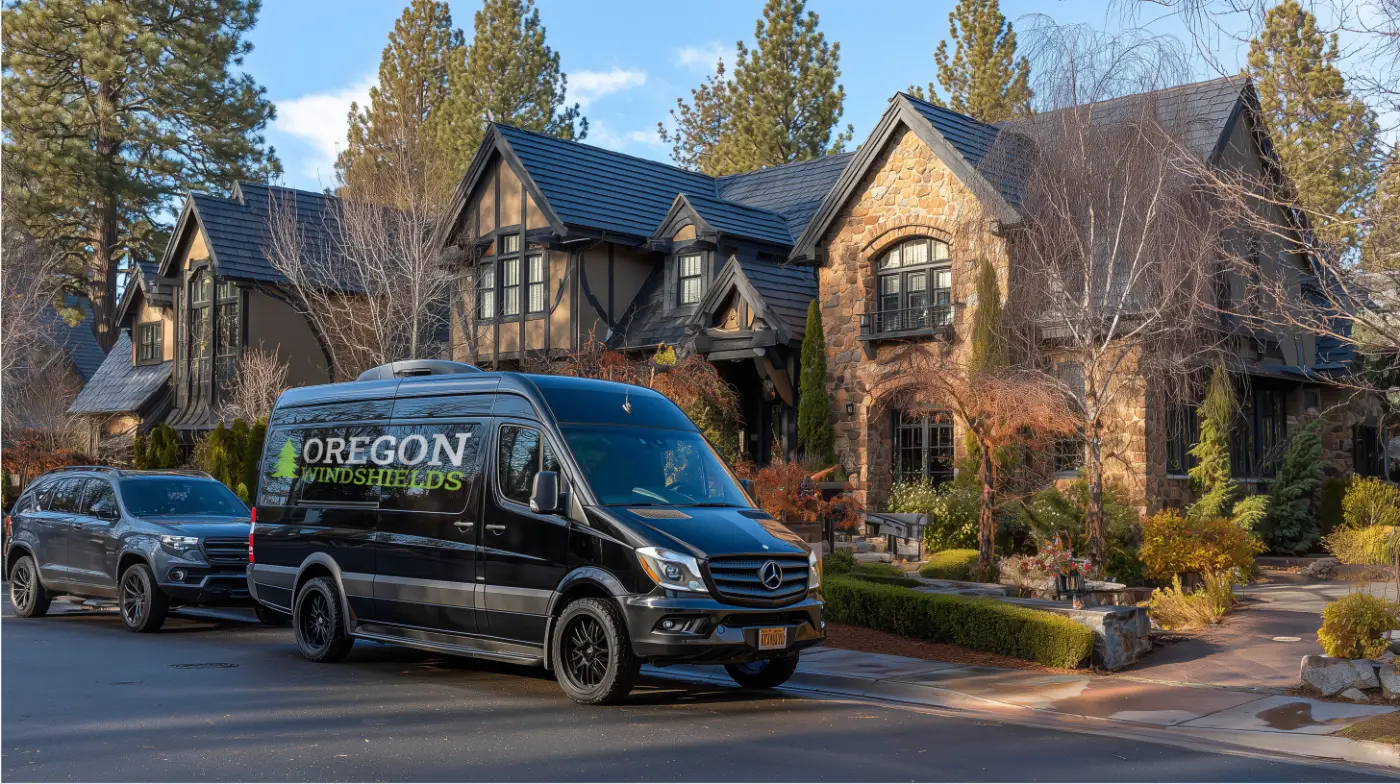
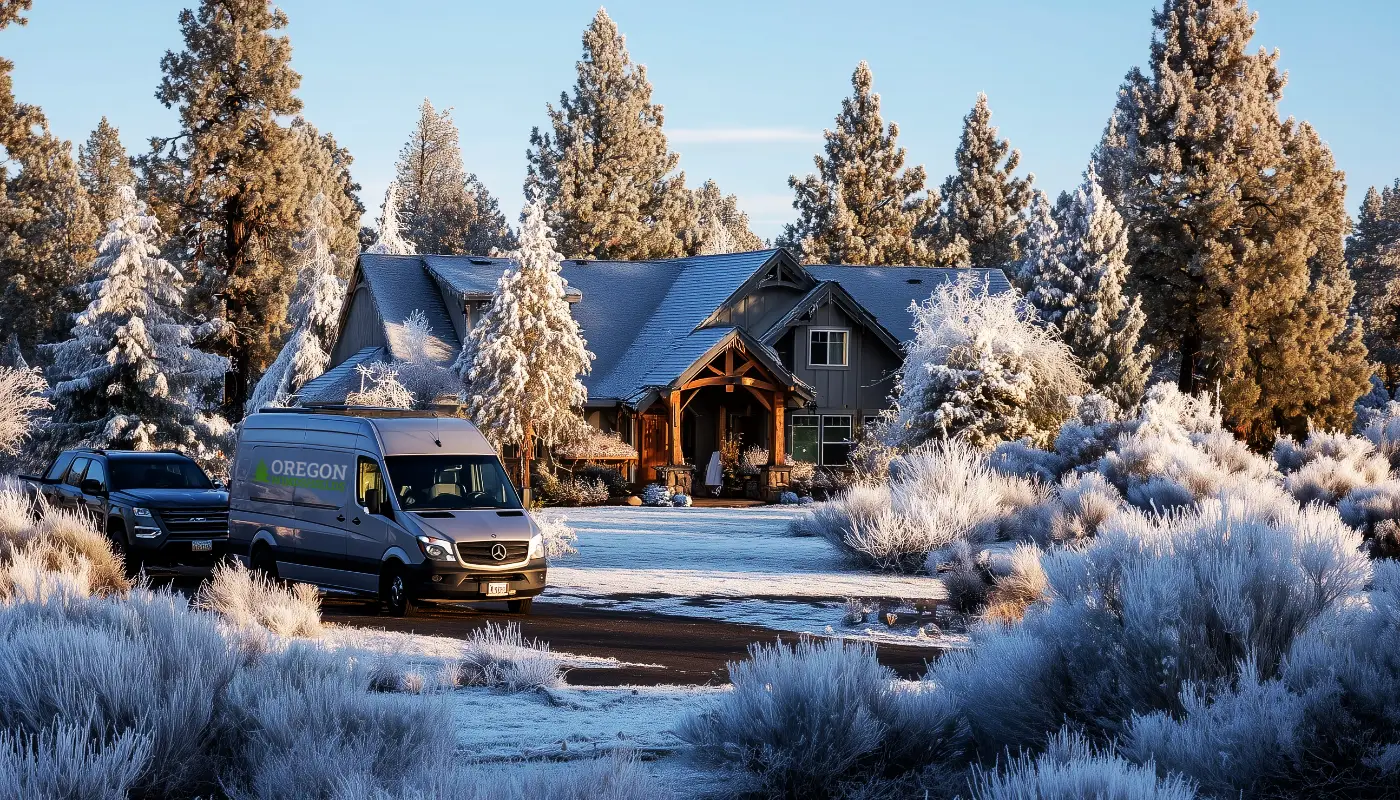
Forty minutes later, Jake's white service van pulled into Sarah's driveway in a quiet residential neighborhood off 27th Street. Frost covered everything—rooftops, lawns, the CR-V sitting in the driveway with its engine running, Sarah warming it up while she watched anxiously from her kitchen window. Jake could see the damage even from the street: a classic freeze-thaw expansion crack, the kind that happened hundreds of times each winter across Central Oregon when water infiltrated chips and then froze overnight, expanding with inexorable force.
He parked parallel to the Honda, positioning his van so the side equipment compartments faced the vehicle. Before even stepping out, he studied the CR-V through his driver's window, conducting that first visual assessment that started every job. The crack radiated from a rock chip on the passenger side, spreading horizontally across the glass. Eight inches, maybe nine. Definitely beyond repair—this needed full windshield replacement Oregon service.
Jake climbed out into the brutal cold, his breath forming clouds in the pre-dawn darkness. The sun wouldn't crest the Cascade peaks for another forty minutes. He pulled his work jacket tighter and approached the Honda, introducing himself to Sarah as she opened her front door.
"Let me take a closer look," he said, pulling a small flashlight from his pocket.
The windshield told its story clearly to trained eyes. The original impact point—a star break where the rock had struck—showed water infiltration marks. The crack extending from it had the irregular, branching pattern characteristic of freeze-thaw damage. Jake ran his hand gently along the windshield's perimeter, feeling the rubber seal, checking for any additional damage or previous poor installation work that might complicate removal.
Then he noticed the small black rectangular housing mounted to the windshield behind the rearview mirror. ADAS camera. He'd expected as much—most Honda CR-Vs from 2020 onward came equipped with the Honda Sensing suite of driver assistance features.
"Okay, Sarah, here's what we're looking at," Jake explained, walking her around to show her the camera. "This is your forward-facing camera for your safety systems—lane keeping, collision warning, all of that. After I install your new windshield, you'll need to schedule adas calibration bend at our shop. It's critical for those systems to work properly."
Sarah's face showed concern. "Is that covered by insurance?"
"Your progressive glass claims phone number approval should include it—most comprehensive policies do. I'll note it on your paperwork and we'll get you scheduled. But first, let's get this windshield replaced."
He walked back to his van and opened the side compartment, revealing an organized arsenal of tools mounted on custom brackets—cold knives, razor scrapers of various grits, suction cups, primer bottles, adhesive guns, safety equipment. Everything had its place, organized through years of refinement into a mobile workspace that rivaled many fixed shops for efficiency.
Jake pulled out his tablet and photographed the damage from multiple angles—documentation for the progressive claim file and his own quality records. He verified the VIN plate visible through the windshield, cross-referencing it against the parts order that had arrived at his shop yesterday afternoon. Part number matched. Year, make, model confirmed. The new windshield waited in his van's climate-controlled storage compartment, kept above forty degrees to ensure the glass and any pre-applied components remained at optimal temperature.
"Timeline is about ninety minutes for the installation," he told Sarah, checking his watch. 7:22 AM now. "Then we need to talk about cure time before you can drive."
Sarah's face fell. "I really need to be at work by nine."
"Let's see what we can figure out," Jake said. "Do you have someone who could give you a ride if needed? Or can you work from home this morning?"
"I can probably work from home," she said slowly. "Let me text my supervisor."
While Sarah handled that, Jake began setting up his mobile workspace. He positioned his truck to block the slight breeze that had picked up—adhesive application needed calm air. He laid protective canvas on the cold driveway where he'd be placing tools and hardware, keeping metal off the frozen concrete. From the van's storage, he pulled out portable LED work lights on adjustable stands, positioning them to illuminate the windshield area. December darkness would last another half hour, and precision work required good light.
Next came vehicle protection. Jake opened the driver's door and spread a heavy protective cover across the seat—old adhesive removal got messy, and he'd learned long ago that protecting customer interiors wasn't optional; it was fundamental respect for their property. A second cover went over the dashboard, designed to catch any falling glass particles or adhesive remnants. He taped protective sheeting along the A-pillars and roof liner, creating a barrier against accidental damage during the extraction process.
Outside, he carefully removed both wiper arms, labeling them left and right. Cold weather made the retaining nuts stubborn, but twenty years of experience had taught him exactly how much force to apply. Too little and they wouldn't budge; too much and you risked stripping threads or cracking the wiper arm assemblies. He set them aside on his canvas workspace, arranged exactly as they'd come off.
His tools came next, staged within easy reach: the cold knife that would cut through the urethane adhesive bonding the old windshield to the frame, razor scrapers organized from coarse to fine grit, primer bottles (he checked each—none frozen despite the cold, thanks to storage in his heated van), and the adhesive gun loaded with a fresh cartridge of urethane kept warm until the moment of application.
The new windshield stayed in the truck for now. No point exposing it to eighteen-degree temperatures longer than necessary.
Jake turned to Sarah, who had emerged again from the house, bundled in a heavy jacket.
"Got the green light to work from home," she reported with visible relief.
"Perfect," Jake said. "I'm going to start the removal now—it gets a bit noisy with the cutting and scraping. You're welcome to watch, or you can head inside where it's warm."
"I'll watch for a bit," Sarah said. "I've never seen this done."
Jake smiled. Most customers found the process fascinating once they saw the precision it required.
He started inside the cabin, carefully removing the A-pillar trim covers that concealed the windshield's edges. These black plastic pieces snapped into place with hidden clips, and cold weather made the plastic brittle. Gentle but firm pressure, applied at the right angles—each piece popped free without breaking clips. He worked methodically, placing each piece in sequence on the passenger seat so reassembly would be straightforward.
The rearview mirror presented the next decision point. This Honda used a permanent bonding button on the windshield rather than a removable bracket. He'd work around it carefully during removal rather than risk damaging it.
Now for the critical part: removing the windshield itself.
Jake selected his cold knife—a tool that looked like an oversized utility knife with a long, thin blade designed specifically for cutting urethane adhesive. He chose his starting point: the lower passenger-side corner, away from any antenna wiring or sensor connections that might complicate the initial penetration.
Finding the adhesive layer required feel developed over thousands of installations. Too shallow and you'd scratch paint or cut interior trim. Too deep and you might damage the pinch weld—the metal frame that the windshield bonded to. Jake inserted the blade at precisely the right angle, feeling that familiar resistance as steel met urethane.
Then he began cutting, using a smooth sawing motion that felt like cutting through very firm rubber. The sound—rhythmic, repetitive—echoed in the cold morning air. Sarah watched, fascinated, as Jake worked his way methodically around the entire windshield perimeter, the blade following the edge with practiced consistency.
This CR-V had thicker adhesive than newer models—probably eight to ten years old based on the VIN, and older vehicles often used more generous adhesive beads. Jake adjusted his technique, making multiple passes in some sections to ensure complete separation. His hands knew this work intimately; muscle memory guided the blade while his mind monitored for hidden clips or fasteners specific to Honda's engineering.
Twelve minutes later, he'd cut completely around the perimeter. Time to test the seal.
Follow a maintenance program
Ante gravida id aenean quis egestas risus nam amet nullam leo diam diam aliquam eu eu malesuada arcu rhoncus suspendisse nulla mattis ut amet sagittis in justo egestas.

search for a trusted mechanic
Lorem ipsum dolor sit amet, consectetur adipiscing elit lobortis arcu enim urna adipiscing praesent velit viverra sit semper lorem eu cursus vel hendrerit elementum morbi curabitur etiam nibh justo, lorem aliquet donec sed sit mi dignissim at ante massa mattis.
- Neque sodales ut etiam sit amet nisl purus non tellus orci ac auctor
- Adipiscing elit ut aliquam purus sit amet viverra suspendisse potent
- Mauris commodo quis imperdiet massa tincidunt nunc pulvinar
- Excepteur sint occaecat cupidatat non proident sunt in culpa qui officia
Check the air pressure in your tires
Vitae congue eu consequat ac felis placerat vestibulum lectus mauris ultrices cursus sit amet dictum sit amet justo donec enim diam porttitor lacus luctus accumsan tortor posuere praesent tristique magna sit amet purus gravida quis blandit turpis.
Review your suspension frequently
At risus viverra adipiscing at in tellus integer feugiat nisl pretium fusce id velit ut tortor sagittis orci a scelerisque purus semper eget at lectus urna duis convallis. porta nibh venenatis cras sed felis eget neque laoreet suspendisse interdum consectetur libero id faucibus nisl donec pretium vulputate sapien nec sagittis aliquam nunc lobortis mattis aliquam faucibus purus in.
- Neque sodales ut etiam sit amet nisl purus non tellus orci ac auctor
- Adipiscing elit ut aliquam purus sit amet viverra suspendisse potent
- Mauris commodo quis imperdiet massa tincidunt nunc pulvinar
- Excepteur sint occaecat cupidatat non proident sunt in culpa qui officia
Service your vehicle as regularly as posible
At risus viverra adipiscing at in tellus integer feugiat nisl pretium fusce id velit ut tortor sagittis orci a scelerisque purus semper eget at lectus urna duis convallis. porta nibh venenatis cras sed felis eget neque laoreet suspendisse interdum consectetur libero id faucibus nisl donec pretium vulputate sapien nec sagittis aliquam nunc lobortis mattis aliquam faucibus purus in.
“Nisi quis eleifend quam adipiscing vitae aliquet bibendum enim facilisis gravida neque velit euismod in pellentesque”
Conclusion
Eget lorem dolor sed viverra ipsum nunc aliquet bibendum felis donec et odio pellentesque diam volutpat commodo sed egestas aliquam sem fringilla ut morbi tincidunt augue interdum velit euismod eu tincidunt tortor aliquam nulla facilisi aenean sed adipiscing diam donec adipiscing ut lectus arcu bibendum at varius vel pharetra nibh venenatis cras sed felis eget.
Jake attached two heavy-duty suction cups to the windshield, one on each side, positioned for balanced lifting. He applied gentle upward pressure, testing whether the adhesive had fully released. Slight movement—good. More pressure, angling the windshield forward at the top while keeping the bottom edge near the dashboard. The seal broke with a subtle sound, and the windshield lifted free from the frame.
This was always a critical moment. Damaged windshields were unpredictable—the crack pattern could cause the glass to fracture further during removal, creating sharp edges and potential injury. Jake maintained steady, controlled pressure as he lifted and angled the windshield out past the rearview mirror, the dashboard, and finally clear of the vehicle opening.
The glass was heavy—roughly twenty-five pounds of laminated safety glass—and awkward to carry. Cold air made it feel even more brittle. Jake walked carefully across the frosty driveway to his van, securing the old windshield in a designated disposal compartment. He paused to examine it one more time under his work lights. The crack pattern told the classic freeze-thaw story: moisture infiltration at the chip, ice expansion creating internal pressure, and the explosive branching pattern when the glass finally failed. He'd seen hundreds just like it.
Back at the Honda, Jake studied the now-exposed pinch weld—the metal frame that would bond to the new windshield. This was the foundation of everything that followed. A proper installation started here, with this preparation work that customers never saw but that determined whether their windshield would last ten years or fail in ten months.
The frame looked good overall: no rust, no damage from the previous installation, no signs of structural compromise. But it was covered in old adhesive that needed removal, and that's where inexperienced technicians often cut corners. The urethane had to be scraped down to a specific height—1 to 2 millimeters remaining. Remove too much and you'd compromise bonding strength. Leave too much and the new windshield wouldn't seat properly, creating gaps and potential leaks.
Jake selected a sharp razor scraper and began the methodical work of adhesive removal. This was meditation through repetition: shallow blade angle, even pressure, working section by section around the entire frame. The old urethane was tough, especially in cold weather, resisting the blade like hardened rubber. Corners and curves required extra care—rushing here meant gouges in paint or damaged pinch weld.
Twenty minutes of steady work reduced the old adhesive to a uniform 1-2mm layer around the entire frame. Jake ran his hand along the perimeter, feeling for inconsistencies. Smooth. Even. Perfect.
He spotted one small rust area on the lower passenger corner—common on vehicles that had seen several Central Oregon winters. Out came the wire brush, removing loose rust with quick, efficient strokes. Then rust converter applied to the clean metal, a chemical treatment that neutralized remaining corrosion and prevented future spread. He waited three minutes for the reaction, then wiped the area clean.
Now for final cleaning—the step that created the molecular bond foundation. Jake pulled alcohol wipes from his supplies and cleaned the entire pinch weld surface, removing any remaining debris, oils, moisture, or contaminants. Clean surface equaled proper adhesion. One last inspection: he checked the cowl drain area where the windshield's lower edge would meet the hood, clearing a few trapped pine needles that could compromise the seal.
The frame was ready. Now came primer—the chemical bonding agent that created adhesion between new urethane and old metal surfaces.
Jake worked quickly, applying black primer to the entire pinch weld with a small brush. Even coating, no drips, working efficiently before the cold could slow the primer's flash time—the brief period it needed to cure before adhesive application. Simultaneously, he'd need to prime the new windshield's edges, creating bonding surfaces on both the glass and the frame.
While the frame primer began its flash cure, Jake opened his van's climate-controlled storage compartment. Inside, wrapped in protective plastic, waited the new windshield. He pulled it out carefully, double-checking the part number stamped on the glass against his order sheet one final time. Critical verification—installing the wrong windshield meant starting over, wasting hours and potentially leaving a customer stranded.
Part number matched perfectly. Jake unwrapped the plastic and inspected the glass under his work lights. No chips, no cracks, no manufacturing defects. DOT certification marks present. Tint band at the top matched the original. The ADAS camera mounting bracket was pre-installed and properly positioned. Rain sensor placement looked correct.
Perfect.
He applied glass primer around the windshield's entire perimeter edge—the black coating that would bond to the urethane adhesive. Even coverage, no gaps, particular attention to corners where stress concentrated. Then he set the windshield carefully on clean towels while the primer flashed, using this brief window to retrieve and prepare his adhesive.
The urethane cartridge had been stored in his van's heated compartment, maintaining the 60-degree minimum temperature required for proper flow and curing. Jake loaded it into his professional dispensing gun, cut the applicator tip at the correct angle to produce an 8-10mm bead—the height specified for this vehicle's make and model—and did a test squeeze to verify consistent flow.
Temperature check: adhesive warm, frame above freezing (the running vehicle had warmed it slightly), glass at workable temperature. All systems go.
Jake positioned himself at the Honda's passenger side and began applying adhesive to the pinch weld, starting at bottom center and working methodically around the entire perimeter. This was craftsmanship—steady pressure on the gun trigger producing a continuous bead with no breaks, no gaps, no inconsistencies. The urethane emerged in a perfect triangular cross-section, the shape that provided optimal bonding surface area.
He worked with practiced rhythm, smooth steady motion, watching the bead height and adjusting pressure microscopically to maintain consistency. Slightly higher beads at the corners where stress would concentrate during temperature changes and vehicle flex. Complete circuit around the frame, ending where he'd started with a seamless connection that showed no overlap gaps.
Visual quality check: even height, no valleys, no peaks, proper triangular shape throughout. Time elapsed: four minutes. Perfect. Urethane had limited open time before it started forming skin, but cold weather extended this working window. Still, no time to waste.
Everything was ready for the critical moment: installation.
Jake walked to where the new windshield rested on its protective towels. He attached suction cups—one on each side, positioned for balanced lifting and precise control. Twenty-five pounds of glass, expensive and fragile, about to be positioned within millimeters of accuracy into fresh adhesive that would grip it permanently within seconds of contact.
This was where two decades of experience made the difference.
Follow a maintenance program
Ante gravida id aenean quis egestas risus nam amet nullam leo diam diam aliquam eu eu malesuada arcu rhoncus suspendisse nulla mattis ut amet sagittis in justo egestas.
search for a trusted mechanic
Lorem ipsum dolor sit amet, consectetur adipiscing elit lobortis arcu enim urna adipiscing praesent velit viverra sit semper lorem eu cursus vel hendrerit elementum morbi curabitur etiam nibh justo, lorem aliquet donec sed sit mi dignissim at ante massa mattis.
- Neque sodales ut etiam sit amet nisl purus non tellus orci ac auctor
- Adipiscing elit ut aliquam purus sit amet viverra suspendisse potent
- Mauris commodo quis imperdiet massa tincidunt nunc pulvinar
- Excepteur sint occaecat cupidatat non proident sunt in culpa qui officia
Check the air pressure in your tires
Vitae congue eu consequat ac felis placerat vestibulum lectus mauris ultrices cursus sit amet dictum sit amet justo donec enim diam porttitor lacus luctus accumsan tortor posuere praesent tristique magna sit amet purus gravida quis blandit turpis.
Review your suspension frequently
At risus viverra adipiscing at in tellus integer feugiat nisl pretium fusce id velit ut tortor sagittis orci a scelerisque purus semper eget at lectus urna duis convallis. porta nibh venenatis cras sed felis eget neque laoreet suspendisse interdum consectetur libero id faucibus nisl donec pretium vulputate sapien nec sagittis aliquam nunc lobortis mattis aliquam faucibus purus in.
- Neque sodales ut etiam sit amet nisl purus non tellus orci ac auctor
- Adipiscing elit ut aliquam purus sit amet viverra suspendisse potent
- Mauris commodo quis imperdiet massa tincidunt nunc pulvinar
- Excepteur sint occaecat cupidatat non proident sunt in culpa qui officia
Service your vehicle as regularly as posible
At risus viverra adipiscing at in tellus integer feugiat nisl pretium fusce id velit ut tortor sagittis orci a scelerisque purus semper eget at lectus urna duis convallis. porta nibh venenatis cras sed felis eget neque laoreet suspendisse interdum consectetur libero id faucibus nisl donec pretium vulputate sapien nec sagittis aliquam nunc lobortis mattis aliquam faucibus purus in.
“Nisi quis eleifend quam adipiscing vitae aliquet bibendum enim facilisis gravida neque velit euismod in pellentesque”
Conclusion
Eget lorem dolor sed viverra ipsum nunc aliquet bibendum felis donec et odio pellentesque diam volutpat commodo sed egestas aliquam sem fringilla ut morbi tincidunt augue interdum velit euismod eu tincidunt tortor aliquam nulla facilisi aenean sed adipiscing diam donec adipiscing ut lectus arcu bibendum at varius vel pharetra nibh venenatis cras sed felis eget.
Jake lifted the windshield, his body remembering the weight distribution, his hands automatically compensating for the awkward size. He walked carefully across the driveway—watching for ice, feeling for secure footing with each step—and approached the Honda from an angle that let him position the bottom edge first.
The technique: bottom edge settles into the adhesive bead at the cowl, creating the initial reference point. Then gently roll the top edge up toward the roof line, bringing all four corners into simultaneous contact with the waiting urethane.
Jake lowered the windshield into position, feeling that first contact as the bottom edge met adhesive. He used distant reference points—the neighbor's fence post, a tree across the street—to verify the glass was level, his eyes reading angles and alignments through decades of calibrated practice. Gently, smoothly, he rolled the top edge up. The moment of full contact: all edges meeting adhesive simultaneously, the glass settling into its designed position.
But this was just placement. Now came fine-tuning—the critical seconds when adjustment was still possible before adhesive grip became permanent.
Jake checked the gaps at all four corners. Driver's side looked perfect. Passenger side showed slightly uneven reveals—the visible gap between glass edge and body panel. Rear looked good. Front needed adjustment. He placed his palms on the windshield and applied gentle lateral pressure, shifting the glass two millimeters toward the driver's side.
He stepped back, checking sight lines from multiple angles. Viewed from the interior, the glass centered perfectly in the opening. From outside, all four corner gaps now appeared even. He ran his hand along the bottom edge where glass met cowl—perfectly flush. Top edge along the roof line—even gap, consistent all the way across.
Perfect.
Now he set the glass with firm, even pressure around the entire perimeter, ensuring full contact between glass and adhesive. This created the molecular bond, urethane grabbing both the primed frame and the primed glass edge. He worked methodically, palm pressure section by section, watching for the telltale sign of proper installation: slight adhesive squeeze-out emerging from between the glass edge and the pinch weld.
There it was—a thin bead of excess urethane appearing all around the perimeter. Perfect. This confirmed proper bead height and complete contact. Too much squeeze-out meant excessive bead height; none meant insufficient adhesive or improper seating. This was just right.
Jake pulled a clean rag and adhesive cleaner from his supplies, wiping away the excess urethane before it could fully skin over. Quick, efficient motions cleaning the edges to professional appearance standards. The windshield was installed, bonded, and set.
Time check: 8:33 AM. Right on schedule.
Now came the finishing details that separated adequate work from quality craftsmanship.
Inside the cabin, Jake began reassembly. The rearview mirror remained properly attached to its bonding button. A-pillar trim pieces reinstalled in reverse order of removal, each clip snapping into place with satisfying clicks. Overhead console, if this model had electrical connections. He tested everything—no loose pieces, no forgotten steps.
He removed the protective covers from the seats, dashboard, and steering wheel, carefully folding them to trap any small debris they'd collected. A quick vacuum with his cordless shop vac captured glass particles and adhesive dust too small to see but capable of causing irritation. The interior looked factory-fresh.
Outside, Jake reinstalled the wiper arms in their labeled positions—left and right, proper orientation, secured but not over-tightened. Cold metal required careful torque to avoid stripping. He tested wiper blade clearance against the new glass, ensuring no contact that might cause squeaking or damage. Perfect clearance.
Final exterior cleaning removed his fingerprints from the glass and any adhesive residue from painted surfaces. Professional appearance mattered.
Then came the moment of truth: the water test.
"Can I use your garden hose?" Jake called to Sarah, who was watching the final stages from her doorway.
"Sure—it's around the side, but it might be frozen."
Fortunately, the hose yielded water after a few seconds of flow. Jake adjusted the nozzle to a solid stream and began spraying around the entire windshield perimeter, focusing particularly on corners and the bottom edge where leaks most commonly occurred. Water sheeted down the glass and cascaded onto the driveway.
He opened the driver's door and checked under the dash, along door seals, and anywhere water might penetrate. Ran his hand over the carpet. Checked the headliner.
Completely dry. Perfect seal.
Jake smiled. Twenty years, thousands of installations, and this verification never got old. Every single one needed to be right.
He spent the next few minutes documenting the completed installation—photographs of the finished work, recording installation time and environmental conditions (18°F ambient, vehicle warmed to approximately 45°F interior), and preparing the paperwork Sarah would need.
8:45 AM. Exactly as promised.
Sarah emerged from her house as Jake finished organizing his tools for transport to the next job.
"All done?" she asked hopefully.
"Installation complete," Jake confirmed. "Let me walk you through what you're seeing and what comes next."
He showed her the quality of the installation—clean edges, even gaps around all four sides, professional finish that matched factory appearance. Sarah ran her hand admiringly along the new glass.
"Now, this is critical," Jake said, his tone shifting to serious. "Don't drive this vehicle for at least two hours—three would be better in this cold weather. The adhesive needs time to cure to safe-drive strength."
Sarah's face showed concern. "I thought I could work from home this morning, but I just got a text—I need to be in the office by eleven for an unexpected meeting."
Jake checked his watch. 8:47 AM. Three hours would be 11:47—cutting it close.
"Here's the absolute minimum: two hours gets you to safe-drive strength, meaning the windshield won't pop out in normal driving. But it won't reach full cure strength for twenty-four hours. Can you drive gently? No highway speeds, no slamming doors, easy on bumps?"
"Yes, absolutely."
"Then 11 AM departure should be okay. But there's something else we need to discuss."
Jake pointed to the ADAS camera mounted behind the rearview mirror. "Your Honda has forward-facing camera and radar systems—lane departure warning, collision mitigation, adaptive cruise control. Right now, those systems think the camera is in one position, but we just moved it by installing a new windshield. Even a few millimeters of change affects accuracy."
"What does that mean?" Sarah asked.
"It means you need adas calibration bend at our shop—it's a service where we use specialized targets and equipment to recalibrate those sensors so they work correctly. Until then, those safety features may not function properly or might give false warnings."
"Is that covered by my insurance?"
"Your progressive glass claims phone number approval should include calibration coverage under your comprehensive policy. I've noted it on your invoice, and here's a card with our shop address and phone number. Can you come in tomorrow afternoon?"
Sarah took the card. "Yes, I can do that. Two o'clock work?"
"Perfect. I'll have my office call you this afternoon to confirm the appointment."
Jake pulled out his tablet and walked Sarah through the invoice: parts cost, labor, the $100 deductible her Progressive policy required, total charges. The claim approval number from her progressive glass claims phone number call last night appeared at the top of the paperwork.
"Everything else is direct-billed to Progressive," Jake explained. "You just owe the deductible."
Sarah processed the payment through his mobile card reader, and Jake emailed her a receipt with full warranty information.
"Lifetime warranty on the installation," he said. "If you ever have any leaks, any issues with the windshield, any concerns at all—call us directly. We'll take care of it."
He handed her a business card and a printed care sheet. "First twenty-four hours: no car wash, no high speeds over sixty, gentle door closing. After twenty-four hours, normal use, but avoid heavy impacts for the first week while the adhesive reaches full cure strength."
"Got it," Sarah said, studying the sheet. "And I'll be there tomorrow at two for the calibration."
"Perfect. One more thing—" Jake gestured toward the windshield. "See that tiny chip? Don't ignore chips anymore. In this climate, they always turn into cracks. Always."
Sarah laughed. "Lesson learned. Thank you so much for getting here so fast."
Jake began packing his remaining tools into the van. Suction cups mounted in their brackets. Adhesive gun back in the heated compartment. Protective covers folded and stored. Used razor blades disposed in his sharps container. Canvas drop cloth shaken clean and rolled. Every item returned to its designated place, the mobile workspace transforming back into an organized traveling shop.
He secured the old windshield for proper disposal—recycling when possible, as laminated auto glass could be processed to separate the plastic interlayer from recyclable glass. Responsible disposal mattered.
8:55 AM. The sun had finally crested the Cascades, painting Bend's snow-covered peaks in pink and gold. The temperature had climbed to twenty-three degrees—practically balmy compared to the eighteen-degree darkness he'd started in.
Sarah waved from her kitchen window as Jake climbed into his van. Another satisfied customer, another vehicle restored to safety, another Central Oregon family back on the road. He felt that familiar satisfaction—not pride exactly, but professional fulfillment. Twenty years of doing this work, and it still mattered. This wasn't just replacing glass; it was restoring safety, maintaining independence, solving problems that disrupted people's lives.
As Jake pulled out of the driveway, his phone buzzed with the next appointment confirmation. Redmond address, 10:30 AM. Toyota Tacoma, rear glass replacement. He mentally inventoried his truck—yes, he had that glass, had the adhesive, had the time to make the thirty-minute drive.
His mind wandered to yesterday's job: an rv windshield replacement bend on a thirty-eight-foot Class A motorhome, the kind of installation that required two technicians and specialized equipment to handle the massive curved windshield. Tomorrow's schedule showed a Subaru Outback with a geico glass claims phone number approval, standard work, probably rock damage like Sarah's Honda.
No two days were ever identical. That's what kept the work interesting after two decades. Different vehicles, different damage patterns, different customer situations. Yesterday an RV, today a Honda CR-V, tomorrow a Subaru. Fleet vehicles for local businesses, classic cars for collectors, family sedans for working parents, luxury SUVs for retirees. Each one mattered. Each one required the same precision, the same commitment to quality.
The variety extended beyond vehicles. Insurance companies each had their procedures—progressive glass claims phone number approvals required different documentation than geico glass claims phone number submissions, different forms than State Farm or Allstate. Jake had learned them all, could navigate any carrier's requirements, could help customers understand their coverage and maximize their benefits.
Then there was the technical evolution. When Jake started in this industry, windshields were simple: laminated glass bonded to frames with urethane adhesive. Now they carried rain sensors, heating elements, antenna arrays, heads-up display components, and most critically, ADAS cameras and radar sensors that required adas calibration bend after every replacement. The work had become vastly more complex, requiring continuous education and investment in specialized equipment.
But the core remained unchanged: precision installation, proper adhesive application, quality materials, and commitment to customer safety. Those fundamentals, learned in his first years and refined through thousands of installations, still guided every job.
Jake turned onto Highway 97, heading north toward Redmond for his next appointment. Traffic was light this mid-morning on a Tuesday. The Cascades dominated the western horizon, Mt. Bachelor's ski runs visible in the clear winter air. Somewhere on those slopes, tourists and locals were enjoying fresh powder, their vehicles parked in lots where windshields faced exposure to cold, sun, flying chains, and all the other hazards that kept mobile glass technicians busy.
He thought about Sarah, probably working from her home office right now, glancing occasionally at her new windshield and mentally counting down to 11 AM when she could safely drive. She'd never think about the installation process again—and that was exactly right. The work Jake did was meant to be invisible. Customers should notice only the results: clear visibility, no leaks, proper fit, safety restored.
They didn't see the decades of training behind each installation. They didn't see the hundreds of small decisions made during removal, preparation, and installation—each one critical to long-term success. They didn't see the quality checks, the precision measurements, the careful adhesive application that meant the difference between a windshield lasting ten years versus failing in ten months.
They saw: broken windshield in the morning, fixed windshield by afternoon.
And that was the invisible expertise of mobile auto glass service. No shop supervisor watching over Jake's shoulder. No controlled environment with perfect temperatures and optimal conditions. Just an experienced technician, a fully-equipped mobile unit, and commitment to quality that didn't waver whether working in a climate-controlled shop or an eighteen-degree driveway.
Whether handling complex rv windshield replacement bend jobs that required special equipment and techniques, navigating progressive glass claims phone number or geico glass claims phone number insurance approvals, coordinating adas calibration bend scheduling for vehicles with sophisticated safety systems, or performing standard replacements like Sarah's Honda—the standard remained constant.
Every installation perfect. Every customer safe. Every job completed with the pride of craftsmanship that couldn't be faked or rushed.
Tomorrow, Sarah would drive to work with her properly calibrated ADAS system, her structurally sound windshield keeping her safe, her visibility perfect. She'd navigate Central Oregon's winter roads with confidence, probably thinking about work projects or her kids' activities or any of the thousand things that occupied daily life.
She wouldn't think about the cold December morning, the methodical preparation, the precise installation, the expertise required. She wouldn't think about the technician who'd arrived in darkness and worked with frozen fingers to restore her vehicle.
And that was exactly how it should be.
Jake merged into the right lane, preparing for his Redmond exit. 9:17 AM. Thirteen minutes until his next appointment. Right on schedule. Another windshield waiting, another customer needing help, another opportunity to practice the craft he'd spent twenty years perfecting.
His phone sat in the center console, ready for the next call. Somewhere in Central Oregon, someone was discovering a cracked windshield, a broken window, a rock chip that needed immediate attention. They'd search for windshield replacement oregon or dial their insurance company's claims number or call a shop directly.
And when they did, technicians like Jake would be ready—mobile units stocked and prepared, expertise refined through decades of experience, commitment to quality unwavering whether the sun was shining or the temperature was below freezing.
This was the invisible work that kept Central Oregon driving safely. This was mobile auto glass service done right. This was craftsmanship that customers never saw but experienced every time they looked through their windshields at the road ahead.
The Toyota Tacoma owner wouldn't know Jake's full story when he arrived in Redmond. Wouldn't know about Sarah's Honda this morning or yesterday's massive RV installation or tomorrow's Subaru. Wouldn't know about the twenty years, the thousands of windshields, the continuous learning and adaptation to new technologies.
But they'd experience the results of all that expertise: professional service, quality installation, and the peace of mind that came from knowing their vehicle was safe.
Jake turned off Highway 97 into Redmond, following his GPS toward the next address. The winter sun climbed higher, warming Central Oregon toward another forty-degree afternoon. By tonight, temperatures would drop back to the teens. Tomorrow morning, someone else would discover freeze-thaw damage, another crack spreading from a neglected chip.
And the cycle would continue—broken glass, urgent calls, mobile technicians responding, precision installations restoring safety.
Twenty years ago, Jake had chosen this career path almost accidentally. Today, he couldn't imagine doing anything else. The work mattered. People depended on it. And done right, with proper expertise and unwavering commitment to quality, it kept Central Oregon's families safe on the road.
That was worth getting up at 6:47 AM in eighteen-degree darkness.
That was worth twenty years of cold mornings and hot afternoons, challenging installations and routine repairs, complex technical learning and unchanging fundamental principles.
That was the satisfaction that came from invisible expertise—the kind customers never saw but benefited from every single day.
Jake pulled into his next customer's driveway, already conducting that first visual assessment, his mind shifting to the Tacoma's rear glass, the specific challenges it would present, the tools he'd need.
Another installation waiting.
Another opportunity to get it exactly right.
Follow a maintenance program
Ante gravida id aenean quis egestas risus nam amet nullam leo diam diam aliquam eu eu malesuada arcu rhoncus suspendisse nulla mattis ut amet sagittis in justo egestas.
search for a trusted mechanic
Lorem ipsum dolor sit amet, consectetur adipiscing elit lobortis arcu enim urna adipiscing praesent velit viverra sit semper lorem eu cursus vel hendrerit elementum morbi curabitur etiam nibh justo, lorem aliquet donec sed sit mi dignissim at ante massa mattis.
- Neque sodales ut etiam sit amet nisl purus non tellus orci ac auctor
- Adipiscing elit ut aliquam purus sit amet viverra suspendisse potent
- Mauris commodo quis imperdiet massa tincidunt nunc pulvinar
- Excepteur sint occaecat cupidatat non proident sunt in culpa qui officia
Check the air pressure in your tires
Vitae congue eu consequat ac felis placerat vestibulum lectus mauris ultrices cursus sit amet dictum sit amet justo donec enim diam porttitor lacus luctus accumsan tortor posuere praesent tristique magna sit amet purus gravida quis blandit turpis.
Review your suspension frequently
At risus viverra adipiscing at in tellus integer feugiat nisl pretium fusce id velit ut tortor sagittis orci a scelerisque purus semper eget at lectus urna duis convallis. porta nibh venenatis cras sed felis eget neque laoreet suspendisse interdum consectetur libero id faucibus nisl donec pretium vulputate sapien nec sagittis aliquam nunc lobortis mattis aliquam faucibus purus in.
- Neque sodales ut etiam sit amet nisl purus non tellus orci ac auctor
- Adipiscing elit ut aliquam purus sit amet viverra suspendisse potent
- Mauris commodo quis imperdiet massa tincidunt nunc pulvinar
- Excepteur sint occaecat cupidatat non proident sunt in culpa qui officia
Service your vehicle as regularly as posible
At risus viverra adipiscing at in tellus integer feugiat nisl pretium fusce id velit ut tortor sagittis orci a scelerisque purus semper eget at lectus urna duis convallis. porta nibh venenatis cras sed felis eget neque laoreet suspendisse interdum consectetur libero id faucibus nisl donec pretium vulputate sapien nec sagittis aliquam nunc lobortis mattis aliquam faucibus purus in.
“Nisi quis eleifend quam adipiscing vitae aliquet bibendum enim facilisis gravida neque velit euismod in pellentesque”
Conclusion
Eget lorem dolor sed viverra ipsum nunc aliquet bibendum felis donec et odio pellentesque diam volutpat commodo sed egestas aliquam sem fringilla ut morbi tincidunt augue interdum velit euismod eu tincidunt tortor aliquam nulla facilisi aenean sed adipiscing diam donec adipiscing ut lectus arcu bibendum at varius vel pharetra nibh venenatis cras sed felis eget.